
A marble fountain should fit the way a garden is used—not just the photograph that first caught your eye. From our factory’s perspective, here is how I approach the setting, stone, space, water system and installation before a carving begins.

Which fountain suits the way your garden is used?
When buyers come to our marble sculpture factory, I start with five questions: who uses the space, where people will see the fountain, how much room is available around the entire basin, how the water will circulate and drain, and who will maintain it. A residence, a hotel and a church need different answers.
| Setting | Priority | Starting direction | Site check |
|---|---|---|---|
| Private garden | Comfortable scale, sound and easy upkeep | A modest tiered or sculptural fountain near a terrace or lawn | Views from home, children and pets, seating, leaves, pump access |
| Hotel garden | Memorable arrival and serviceability | A controlled cascade or centerpiece suited to its architecture | Guest routes, overspray, equipment access, water-management plan |
| Church courtyard | Quiet presence respectful of the grounds | A simple tiered basin or appropriately approved figure | Entrances, accessibility, gathering areas, symbolism and care |
These are design starting points, not fixed size rules. A fountain that feels generous in one garden can obstruct movement in another.
For a private garden, design for daily life
At home, I walk the route between the entrance, patio and seating first. A fountain should be visible where you will actually enjoy it. Close to a terrace, a gentle overflow is often more comfortable than a high jet that sprays chairs or paving. In a narrow garden, a wall fountain or smaller basin may preserve more usable space than a broad, multi-tier design.


Browse our garden fountain design examples before settling on a shape.
For a hotel garden, plan for operation as well as appearance
A hotel fountain must work for visitors and for the staff who maintain it. Where will guests arrive, stop for photographs or move with luggage? Can a technician reach the pump without closing a main route? At an entrance the fountain may need to read from a distance; near dining or lounge seating, a quiet sheet of water can be more considerate than a forceful jet.
Choose a basin and nozzle layout that contains spray in normal wind. Plan a serviceable strainer or filter, a refill method and an accessible drain. The local project team should check public-area electrical safety, accessibility, water hygiene and permits. A beautiful carving is not a substitute for a maintenance plan.

For church grounds, respect the setting first
For a church courtyard, I begin with the building’s materials and sightlines, then discuss the design with the parish or project team. A simple white or warm-toned fountain can provide a quiet gathering point. Choose a religious figure only when it suits the particular setting and has been approved by those responsible; a decorative fountain should not be assumed to have a liturgical role.
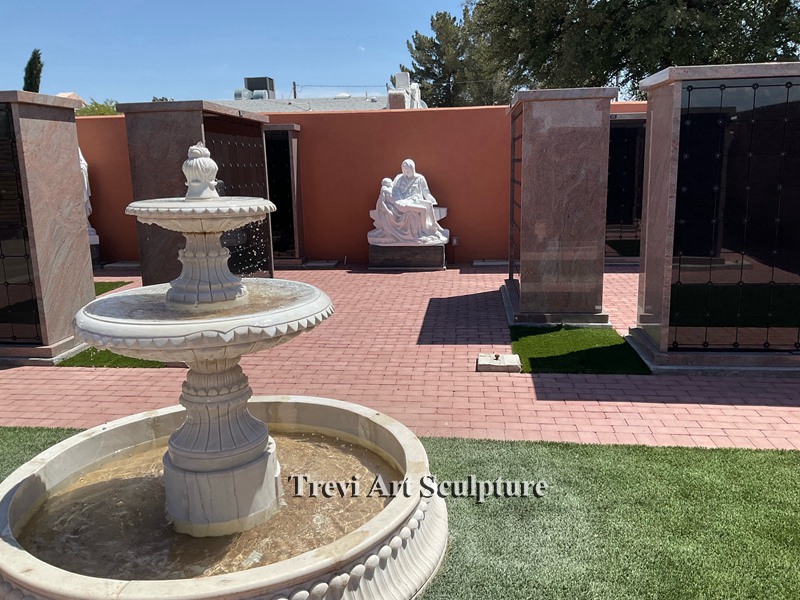
Keep entrances, steps and accessible routes clear. Position the basin so water does not splash onto paving used during services or gatherings. The supplied church-fountain feedback photo shows a tiered fountain and religious sculpture in the grounds, but it cannot verify exact dimensions or installation details.
How do I choose the marble and finish?
When a buyer says “white marble,” I ask what they want it to do visually. Pale stone brings out carved edges against greenery; beige may settle into warm masonry; dark stone can give a formal entrance contrast. Natural veining varies, so ask for samples or close-ups of the actual material. A photograph does not prove a quarry, stone grade or finish.
Marble is useful for detailed figures, lion heads, foliage and classical bowls. For a simpler form in a demanding environment, granite is worth comparing. If a quotation says “marble look,” ask whether it means carved natural marble or a manufactured material. Our guides compare marble with cast stone and different sculptural stones.
I also ask about water and climate. Marble is a calcium-carbonate stone: acidic conditions can gradually erode detail, as the U.S. Geological Survey explains. In a cold region, winter drain-down matters as much as stone choice. No finish makes a water-filled fountain immune to freezing.

How much space should I leave around the fountain?
Measure the whole installation: the outer edge of the lower basin, surrounding paving or planting, splash zone and a route for cleaning. Then check the view from the door, seating, pedestrian approach and upper windows. The mistake I most want buyers to avoid is choosing a basin diameter from a picture before drawing its complete outline on a scaled site plan.
What fountain diameter fits my available space?
For a first discussion, I use these front-court ranges from our circular-driveway sizing guide as a rough proportional reference. The source compares the front court’s area with the outside diameter of the entire fountain basin, not just its center column. It does not specify minimum clearances or the size of a driveway’s center island.
| Outer basin diameter | Approx. front-court area | What I would check next |
|---|---|---|
| 1.5–2.0 m (5–6.5 ft) |
50–80 m² | Paths and seating near the feature |
| 2.0–2.5 m (6.5–8 ft) |
80–120 m² | Comfortable routes on all usable sides |
| 2.5–3.0 m (8–10 ft) |
120–180 m² | The full outline against the entrance axis |
| 3.0–3.5 m (10–11.5 ft) |
180–250 m² | Planting, splash and service access |
| 3.5–4.0 m (11.5–13 ft) |
250–350 m² | Building proportions and circulation |
| 4.0–4.5 m (13–15 ft) |
350–500 m² | Site access and infrastructure planning |
Scale reference, not a minimum-site standard. A long, narrow 120 m² court might not accommodate a 2.5 m basin comfortably. Check the shortest usable width, paths, seating, splash, servicing and any vehicle turning path before confirming a size.

What if it sits in the center of a circular driveway?
Start with turning movement, not sculpture height. Mark the center island and the basin’s outside edge on a scaled plan. Check the swept path of vehicles that actually use the drive—including delivery or emergency vehicles where relevant. Leave room for planting and maintenance without narrowing the vehicle route. Check sightlines, night visibility and whether windblown spray could wet cars or paving. A low cascade may be more practical than a high jet in an exposed approach.

Our driveway-specific guide explores visibility, water effects and circulation in more detail; its size table does not replace a vehicle-turning assessment of your own property.
What must be planned before installation?
From the factory side, I want the stone design and the site preparation to meet on paper before the fountain ships. The local team should confirm:
- A foundation designed for real loads. Obtain component dimensions and weights and account for water and ground conditions. Have a qualified local professional design a stable, level base, reinforcement and anchoring as needed.
- A complete water path. Decide whether the basin is the reservoir or a separate tank is needed. Show pump, supply and return lines, overflow, refill and a drain for cleaning or winter shutdown. Recirculation still needs top-ups and maintenance.
- Serviceable equipment. Agree on an accessible pump cavity or service vault. Do not bury components that need cleaning or replacement; select the pump for actual lift and water effect with the installer.
- Protected power and contained water. Have a licensed local electrician arrange suitable outdoor-rated, protected power to local requirements. Fill and test the fountain, then adjust flow to keep water out of walkways and drive lanes.
- An assembly and handover plan. Check lifting access, numbered stone pieces, joints, sealing and plumbing responsibilities, commissioning, filter cleaning, winter drain-down and replacement-parts contact.
Our step-by-step installation guide covers the base, tiers and pump arrangements. Installation guidance is available, while on-site support depends on location and complexity according to our fountain information page. Confirm drawings, videos, commissioning, travel costs and after-sales scope in the quotation; do not assume an on-site crew is included everywhere.

What should I ask before approving the order?
Send the site, not just an inspiration photo
Before carving, I want an agreed brief: measured plan and photos from key viewpoints; intended use; basin diameter and height; chosen stone and finish; water effect and sound; climate and winter plan; component weights and delivery access; pump and reservoir layout; and the responsibilities of our factory and your local contractor. Ask for a drawing that shows the basin footprint, not merely a front-view rendering.
Budget for the foundation, freight and unloading, local lifting and installation, plumbing, protected power, water management and future servicing as well as the carved stone. Our fountain-cost guide explains the main categories; a site-specific quotation is still essential.
How do I keep a marble fountain attractive?
Remove leaves before they clog the pump intake, maintain adequate water level and check joints and water flow. Clean marble gently with a soft cloth or brush and a suitable neutral stone cleaner. Do not put vinegar, lemon juice or another acidic cleaner on marble. The Natural Stone Institute explains that acidic products can etch calcareous stone and that a sealer helps resist, but does not prevent, staining. Choose water treatments with the stone supplier and local water-service provider, rather than assuming a pool product is safe for the stone, plants or visitors.
Before freezing weather, drain the fountain and exposed lines and follow the pump maker’s storage instructions. For hotels and other publicly accessible sites, assign an owner for regular inspection, cleaning and water-management procedures. Our water-care article covers debris and winter preparation; however, its older vinegar suggestion should not be followed on the marble surface.
Frequently asked questions
Can I install a marble fountain on an existing patio?
Possibly, but not on paving alone without checking the structure beneath it. A qualified local professional should assess the loaded weight, drainage and lifting access before you choose the model.
Does a recirculating fountain need a water connection?
Not always; many systems can be filled and topped up manually. A large or busy site may benefit from planned refill and overflow. In every case, provide a way to drain it and reach the pump.
Wall or tiered fountain for a small garden?
A wall fountain can preserve circulation in a narrow space. A tiered design works when you can view and service it from several sides. Decide from the measured footprint and desired sound.
Can one design work for a church and a hotel?
Yes, but the brief changes. A church may need restrained sound and appropriately approved imagery; a hotel prioritizes guest flow, visibility and a serviceable water system.
Does your factory install the fountain after delivery?
We provide installation guidance. On-site support depends on the location and the project’s complexity, as described on our fountain page. Confirm the precise scope and costs in your quotation.
Start with your site plan.
Send us the dimensions, a simple layout, photos from the main views and tell us whether this is for a home, hotel or church. At Trevi Art Sculpture, those details give us a sound basis for discussing a custom fountain, stone and water effect with you and your local installer.